

Stela
Forum Replies Created
-

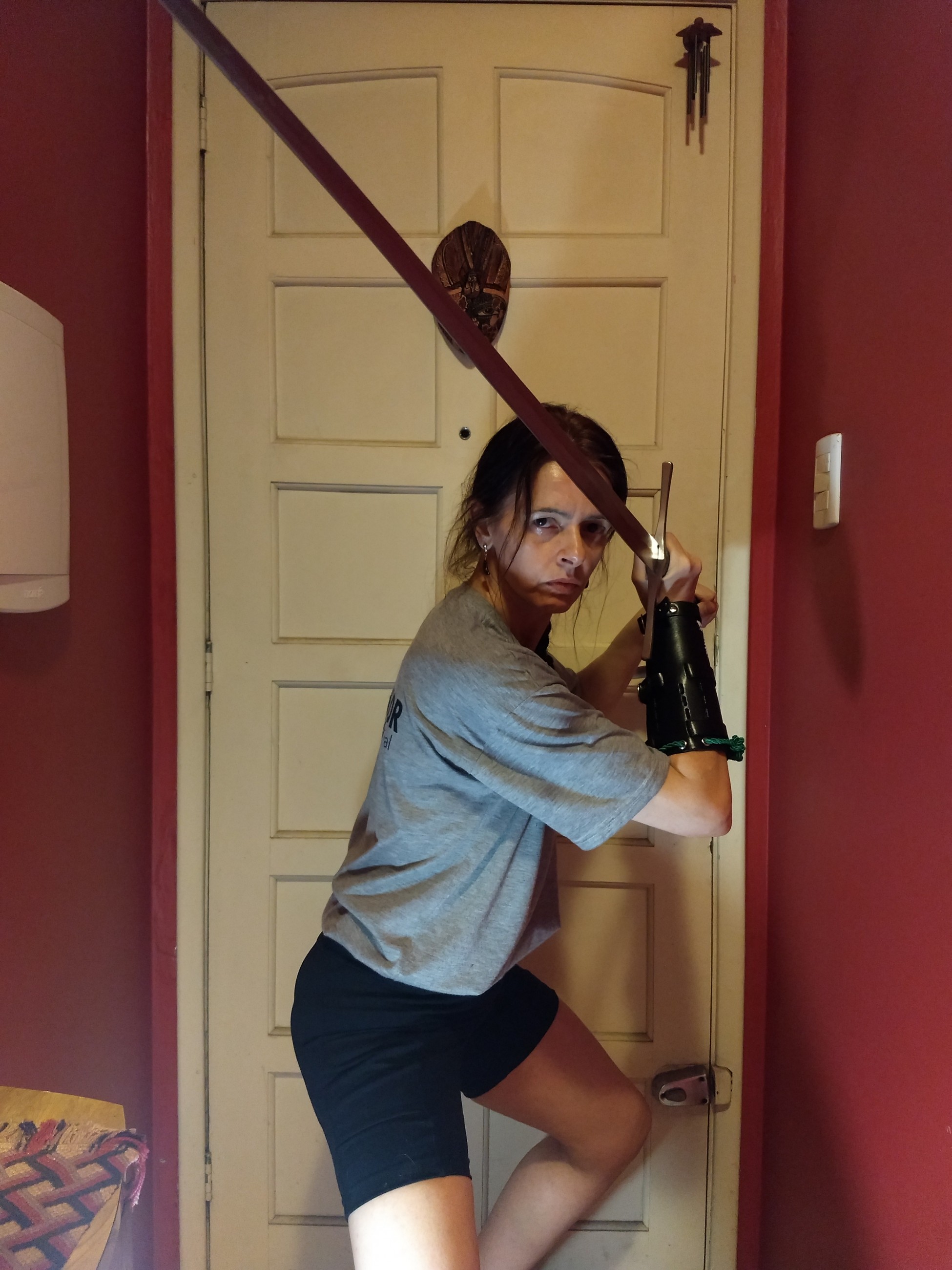
Hey @thomas.belloma , here’s my interpretation of your play.
Hope I got some parts right. I struggle a little with the volta stabile of the sword with pivot step. I ended up choosing a footwork that I thought fitted best what came afterwards.
-
I was able to do just as much as you in this course, and with the same difficulties about partnered exemplars.
Devon explains about this course at the end of the second part of the Sunday Masterclass of week 5 (“Fiore by the book” lecture, starts aprox. at 3:34:45).
There he says it will be available in perpetuity.
🌞
-
How I got to this interpretation:
This is the 3rd student of the remedy master of gioco stretto.
This action follows a crossing in the middle sword.
My starting point was what Devon said in the masterclass, that the bind of the gioco largo masters probably derive from an attack from the player, which the master started to defend, because the player has his right foot front while the master keeps his left. So I got the idea that, by default, the actions in the system start with swords on the right, and left foot front .
Based on this premise, I assumed that, as the gioco stretto master has his right foot front, in this case he had started the attack with a mandritto fendente, the player started to parry, and the master deviated to the sword, getting to the bind.
The third scholar gives a very simple and direct solution from that situation of his master, because he simply turns up the pommel, keeping both hands on it, and steps forward with his left foot, passing his sword under the crossing and throwing the pommel into the teeth of the player.
As the texts says, make this strike quickly, this is the most important piece of advice. There is no need to hold down the player’s hand (as in the 2nd student) if you advance quickly with both hands on the pommel and the weight of your body against his jaw.
So my interpretation of this action is the simplest and most direct way to achieve the results described in the text and picture.
-
-
The whole dive into Fiore’s history and works, as well as the methodology for approaching historical manuals, stood out very strongly. This module is absolutely essential to prove that studying swordplay goes beyond learning a collection of tricks (to recall something that came up during the live sessions). Through this module, the context emerged as a very important aspect of these studies.
It was very revealing to understand that the original instructions left by Fiore were very laconic, and that a great deal of thinking and experimenting was done before his teachings could be organized into a well ordered curriculum in a palatable fashion for us post modern people.
I really cannot say that I met my objectives with this week’s material, because I feel it is yet far beyond my capacity to fully understand and put it to use.
What I will do differently from now on is to be still more committed to my purpose of learning this art.
-
This is a gret topic to think about.
Maybe balance could come by also valuing the swinging the sword around for fun, and not considering it just low quality practice time.
Mindful sessions with attention in granular level are really important. But I think fluidity, ease and finesse are also qualities of a skilled swordsperson, and these qualities only come after thousands of hours of sword in hands, doing and doing again. So, reciting forms and repeating swinging drills is also an important part of the process. I think in any art that depends on developing physical prowess, quantity shouldn’t be dismissed as less important than quality (here understood as hardworking, intellectually invested practice, as you put it). So, these are my two cents on balance for this discussion.
-
The order here is not about preference, it’s a chronological order of reading that I did.
I use these books to understand martial ethic.
1. Ramon Lull. Livro da Ordem de Cavalaria. The author was a former knight himself, later totally dedicated to the carholic church. It’s a book that talks of an idealized “order of chivalry”, by attributing “righteous” virtues to the so called knights. There should be some kind of free soldiers to “mantain and defend the holy catholic faith”. They are free because they are not attached to anything, ideally. They go about righting wrongs. and they fear the punishment from the church, from god, if they misbehave. They are above the lay people in virtues and strength. They are honored and certainly very proud, but they know the best virtue is to stay humble. This is just one interpretation, for nothing is really explained. In reality, I see it as a book of virtues, a kind of book to teach good manners, morals or a kind of ethic through the miths of chivalry.
2. Geoffroi de Charny. A knight’s own book of chivalry. This one is supposed to contrast with the previous one, in a sense that it is a veritable knight talking. It is also a book of virtues, but more prosaic and mundane. The historical introduction gives some knowledgeable insight on the historical circumstances of the book from a contemporary point of view,
3. B. Ann Tlusty. The martial ethic in early modern germany. A contemporary researcher’s book on what was to be a man with weapons int he 15 – 16 centuries. She tells stories that were inferred from documents of public affairs. She talks about the sources of rules, such as the costumes, the regional institutionalized rules, the segment rules, such as those of military men. She talks about what it meant to have certain kinds of weapons at home, to have the right to bear them, or tho have duties concerning maintaining and being able to use weapons to collaborate in the communal defense. Through some narratives of judicial disputes, it is possible to understand how some things were considered right or wrong, and what was considered worth using those weapons for.
-
Some more records of the holydays!
I like to shoot new videos in different places. Watch at least to see if you like the landscapes. They’re on a small beach town in the south of Brazil, called Arroio Teixeira.
I put here a 12-poste where I did a second run with quick flow. Kinda like it.
The fundamental cuts is a classic. I need to take better care of the high final cuts, the point shouldn’t be so high, i think.
The5-thrust also is a basic one . I should remember to not keep the blades so vertical, as in the last one.
Still struggling with the scholars assault. I want to make it something natural and martial-like. Well I want it from all the forms and drills. That’s my goal.
-
Holydays at the beach.
Trying some improvisation, shadow swording.
I think from the finestra at 0:24 until 0:58 some interesting moves came up.
-
Since there is no training log for April yet, and I didn’t say anything in March, there goes something.
Littlle by littlle does the trick. I still look like a child with a sword in hands but it’ s definitely better than It was before. So this is the way. My standards are high.
I can see some improvement in my grounding and It is super important.
I am working on trying to feel more liberty in my arms, on having more extension in them and trying to feel the sword as if It were lighter, If It makes any sense.
Here até the fundamental cuts again. Extremely important drill to practice a lot of cuts in a row, with no distraction from complicated footwork.
-
Ghost dummy 👻
-
There’s a slight difference in the beginning. Maybe I didn’t describe it too clearly. Nice work!
Her’s my version:
-
Nice flow and creative footwork. It seems you are well defended behind your sword all the time.
-
Thanks for the feedback and questions. I really had to get up and experiment here to try to explain some choices that had not been rationalized, although I clearly made them physically.
The horizontal keeping of the sword during the rotation from the bind to the pommel strike is due to the fact that, in this way, I use the true edge to keep pushing my opponent’s sword away. I don’t want to undo the bind too soon because this contact is the fulcrum on which my lever turns.
As for the hit, I imagined a forward push of the pommel into the face after the turn of the sword. This is why I said the weight of my body would help. Although the sword is turning, I keep moving forward. The straighter the vector of force forward, the better.
Boy, when we enter this level of analysis things start to get really abstract.
-
Hey Jeremy, interesting interpretation. I worked on the same play, with a different result.
I am curious as to why you chose to start from donna on the left.